Why Formation Now
For many people today, the words faith and leadership sit uneasily together.
What often comes to mind is either a rigid fundamentalism that excludes and harms, or a vague spirituality so unmoored that “anything goes” — especially when actions are justified in the name of a belief. In this landscape, it can feel as though faith and leadership are a dangerous combination, fraught with misuse, contradiction, and loss of trust.
And yet, for most people, a sense of what ultimately matters is also what invites and sustains them to have a meaningful contribution.
In times of challenge, moral complexity, and deep uncertainty, it is often a connection to something greater — something fundamentally good, even when it is difficult to see — that anchors hope, trust in humanity, and a sense of shared interconnected life on this earth. The loss of communion to this deeper source is not neutral; it leaves leaders exhausted, cynical, or quietly alone in their responsibility.
Many faith-based institutions have struggled to keep this flame alive.
Whether through a loss of integrity, a failure of relevance, or an inability to offer a vision of unity and transcendence worthy of real commitment, many organisations have lost the moral and spiritual authority they once held. As a result, purposeful leaders have lost the connection that provided orientations and grounding, precisely at a time when this is needed most.
And yet, across community services, health, education, and social care, leaders continue to carry a deep desire to contribute meaningfully, to serve with integrity, and to participate in something larger than themselves. What they are seeking are not answers or ideology, but tools for transformation — ways of growing the inner capacity required for sustainable, impactful and compassionate leadership in complex times.
This program exists to bring the most powerful professional development available to those who need it to make a difference.

Development, Capacity, and Transformation
Over the past forty years, adult developmental psychology has built a strong body of evidence showing that leaders grow in capacity as they grow in developmental maturity — that is, as the form of mind through which they make meaning becomes more complex, integrated, and inclusive.
This research consistently demonstrates a crucial distinction:
We grow in two distinct but interdependent directions.
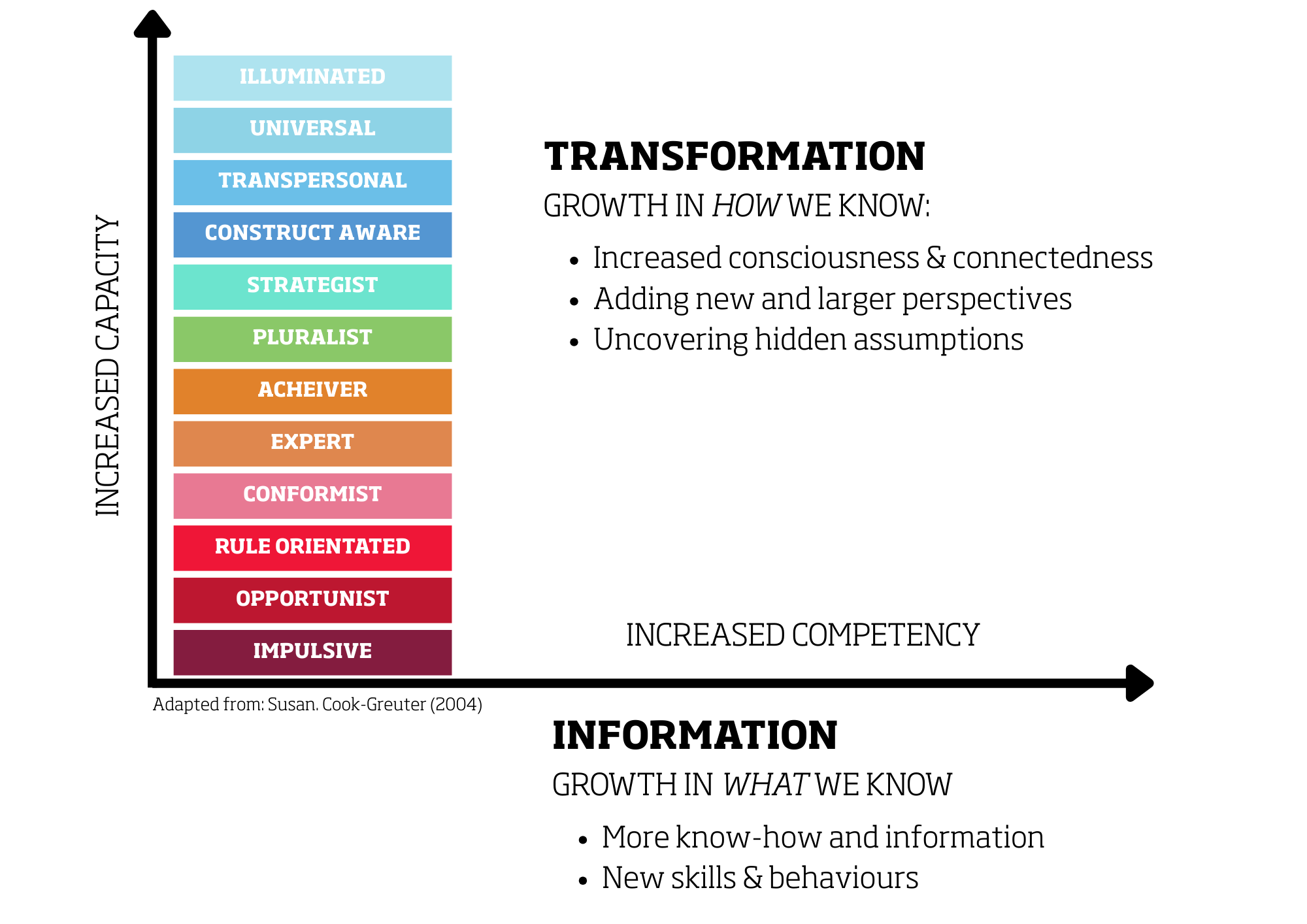
Growth in What We Know (Information)
One form of growth is an increase in information — new knowledge, skills, tools, and technical know-how. This kind of growth builds competence.
Most professional development, training, and coaching is oriented this way. Its aim is to add more content to the leader’s mind: how to manage performance, design workflows, implement policy, or lead teams more effectively. As content increases, competency increases.
This form of development is necessary — but it is not sufficient.
Growth in How We Know (Transformation)
The second form of growth is development in how we know.
This involves a shift in the very structure of meaning-making — the way leaders perceive reality, relate to others, interpret authority, and respond to uncertainty. Rather than adding more information, this kind of growth changes the form of mind itself.
Stages of Adult Development
Just as we recognise stages of development from childhood through adulthood, there are also recognised stages of increasing capacity and complexity that continue throughout adult life and leadership.
As leaders grow vertically, they develop:
• Greater awareness and connectedness
• More integrated and holistic ways of seeing
• Increased capacity to hold paradox and ambiguity
In developmental terms, this is a growth in consciousness — an expansion of awareness beyond earlier limits, enabling leaders to perceive, relate, and respond from a wider and more inclusive perspective.
This is what distinguishes transformation from information.
Why This Matters?
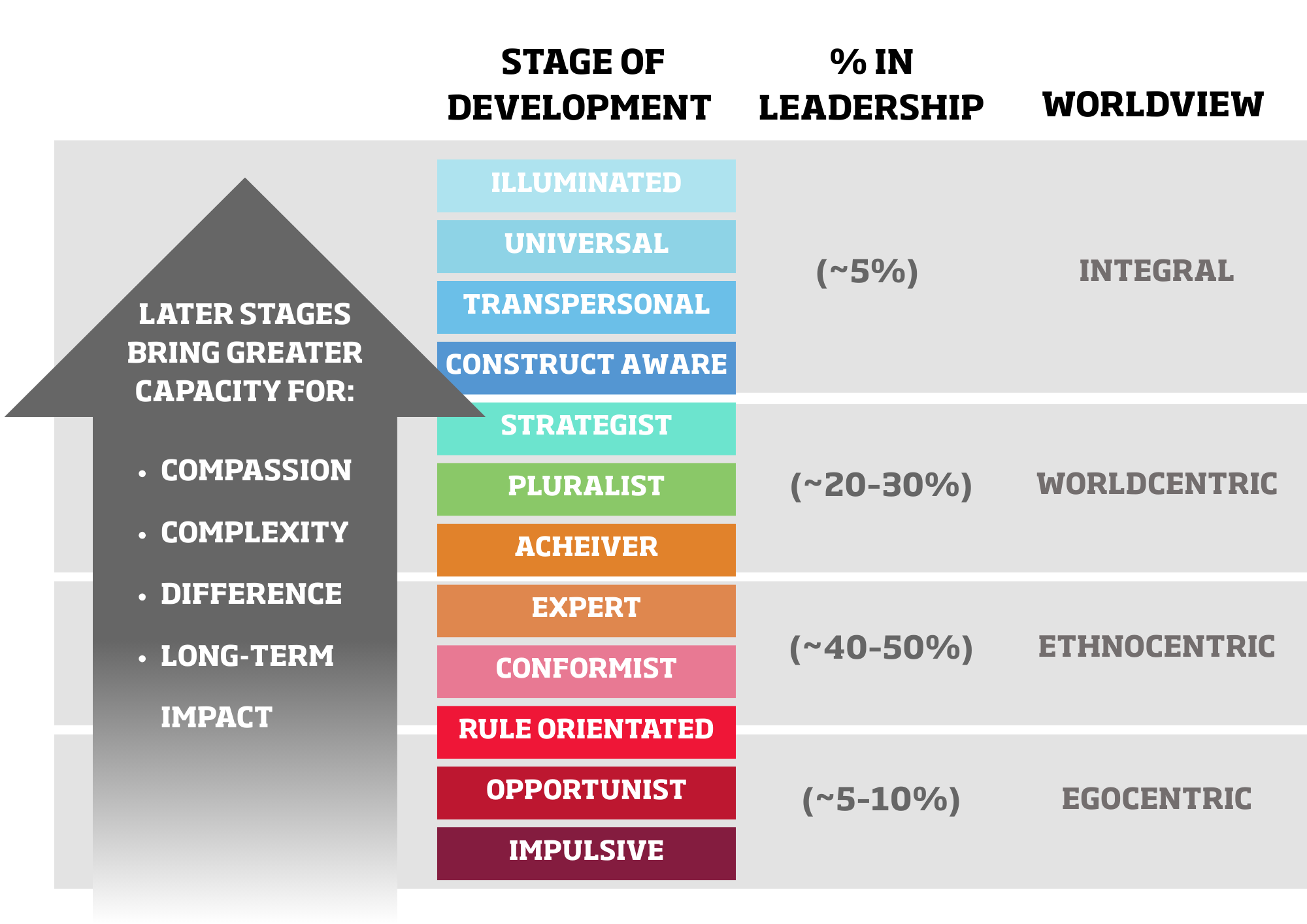
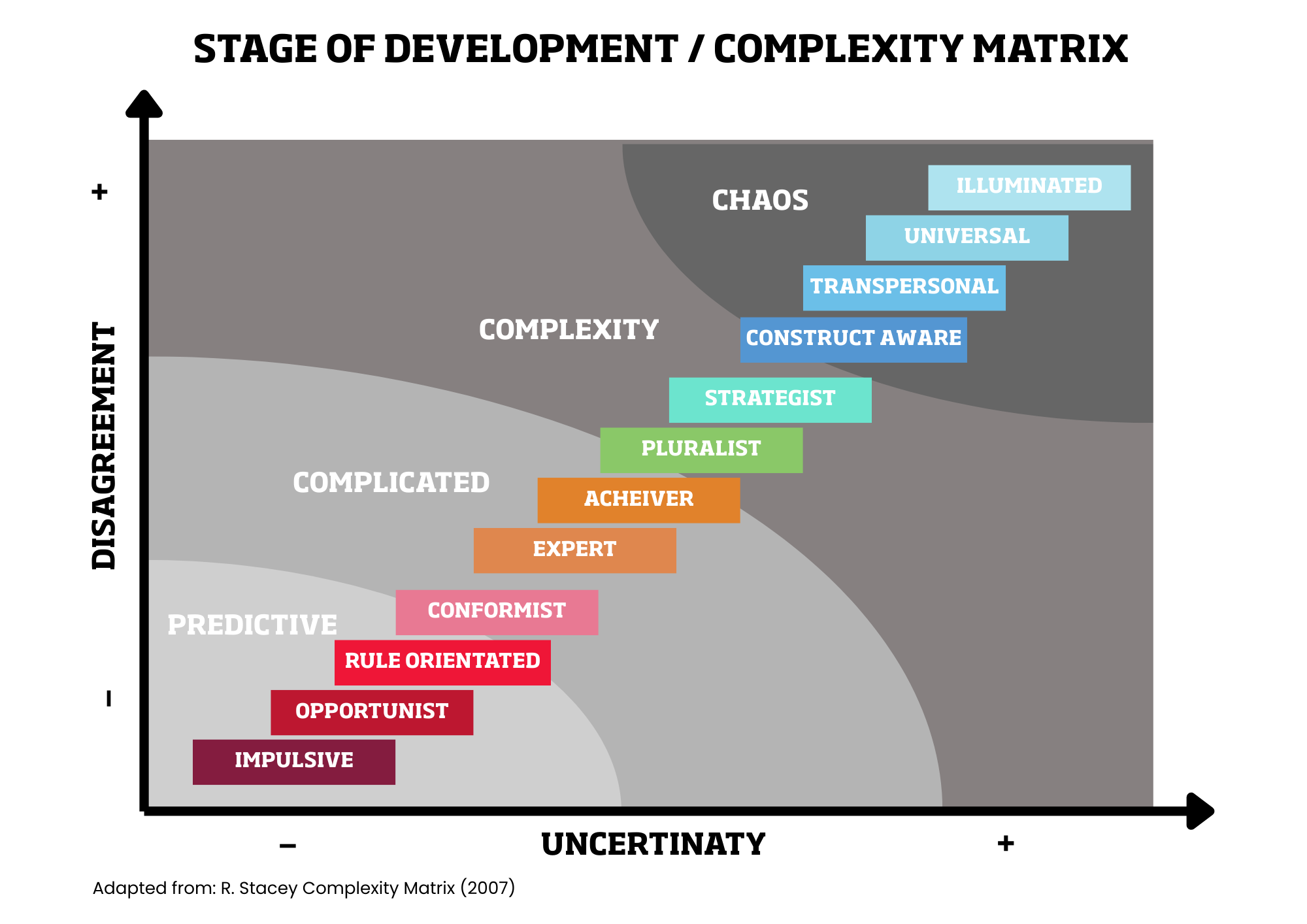
As leaders grow in how they know, each later stage of development brings an increased capacity to:
• hold complexity without collapse
• stay present with difference
• act from maturity rather than reactivity
• discern ethically without certainty
• carry responsibility for the whole
These capacities are not produced by better techniques alone. They emerge through developmental transformation — growth in the inner architecture from which leadership arises.
This is why many leaders today feel that more training is not the answer. What is being asked of them now requires not just more knowledge, but a larger capacity to be with, make sense of, and act wisely within complexity.
This program is designed precisely to support that kind of growth.
The Formation Gap
For many people today — including those often described as spiritual but not religious — faith-based institutions feel increasingly unable to offer guidance that meets the complexity of the world as it is now.
This is not primarily a crisis of belief. It is a crisis of capacity.
In many cases, faith-based organisations have drifted in one of two directions. Some have become tightly bound to state-based funding models and compliance structures, slowly losing the depth and distinctiveness of their spiritual voice. Others have doubled down on doctrinal adherence, offering certainty and boundary at a time when the world is asking for greater compassion, integration, and wisdom.
Both responses are understandable. Neither is sufficient.
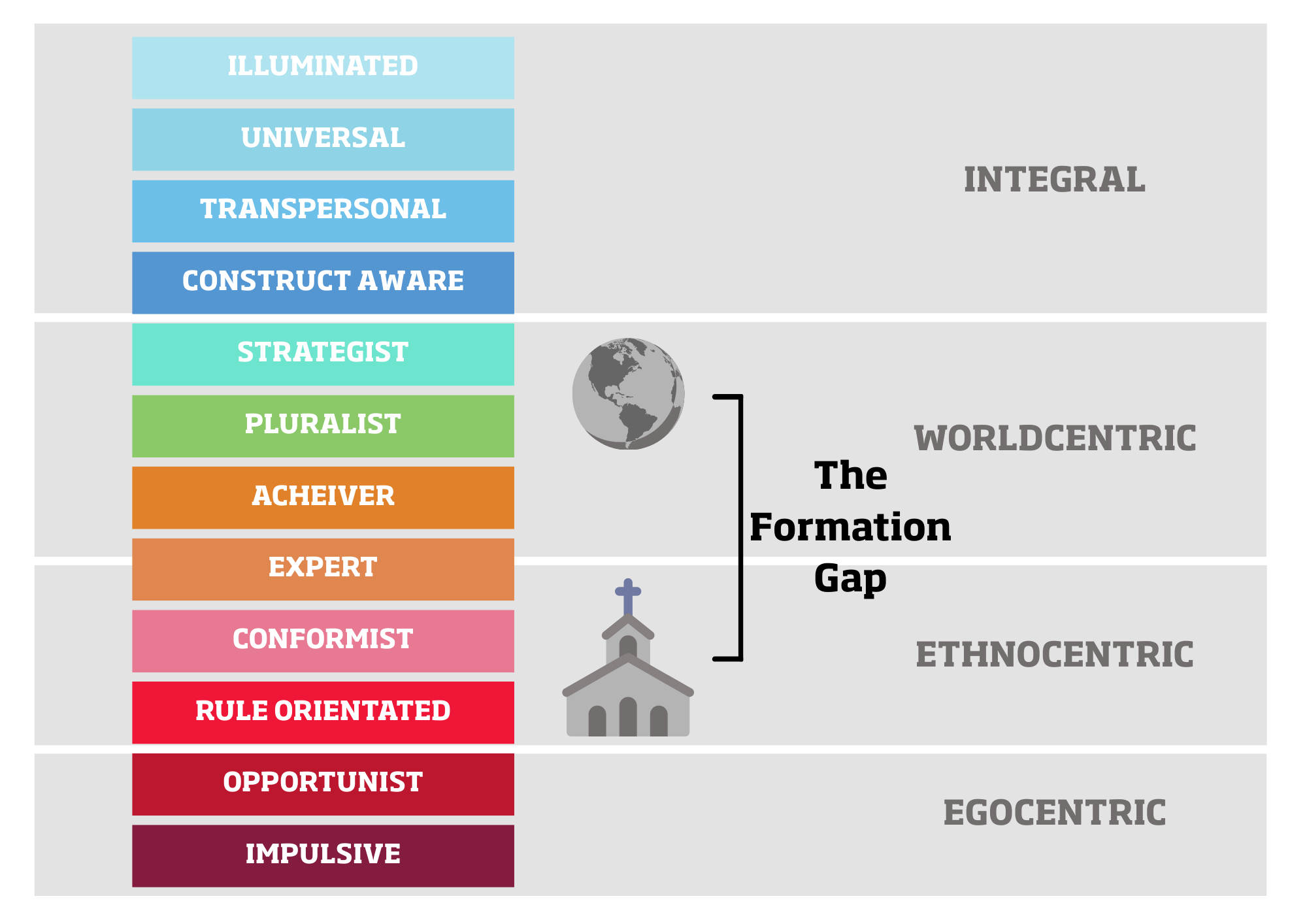
Many communities have worked hard to equip their people with a deeper understanding of teachings, principles, and beliefs — supporting clarity about what is right and what is true. However, over time, knowing the right things has been mistaken for development or itself.
But developemnt is not primarily about what you know.
It is about how you know.
The markers of faithfulness — belief, practice, commitment, and devotion — are important. Yet they are not reliably correlated with maturity. A person or institution can be deeply sincere and devout, while still lacking the developmental capacity required to navigate pluralism, complexity, and difference.
As a result, many faith-based organisations remain operating from an ethnocentric level of development — able to sustain shared identity and deep commitment within their own community, but increasingly ill-equipped to engage a world that is global, plural, and morally complex.
This mismatch between the complexity of the world and the developmental capacity of institutions is what we name the Formation Gap.
Formation is development at the level that matters most — the slow, relational, and integrative growth of consciousness, maturity, and presence. It is the movement toward expanded, more integrated ways of knowing that can hold complexity without collapse, engage difference without fear, and act with wisdom rather than certainty.
A developmentally informed leadership program does not replace faith. It helps faith-based leaders reclaim formation as what development was always meant to be: the cultivation of inner capacity sufficient for love, discernment, and responsible action in a complex world.
This Program puts the “Development” back into 'Professional Development'
By integrating developmental coaching, contemplative practice, and collective learning, the Leader Formation Program reclaims formation within professional development — ensuring leadership development does what it was always meant to do:
support the unfolding of human capacity in service of others.

Recover the Inner Source
Formation reconnects leaders to the inner condition from which leadership arises — the “who” behind the “how” and the “what.”
Rather than leading primarily from role, pressure, or expectation, leaders learn to act from presence, discernment, and grounded authority.

Integrate Depth with Professionalism
Developmental psychology affirms what the contemplative tradition has always known:
Sustainable impact depends not only on skill, but on consciousness.
This program integrates faith, contemplative practice, and developmental leadership with professional excellence — ensuring that growth in competence is matched by growth in capacity.

Renew Culture Through Leadership
Culture reflects the consciousness of its leaders.
As leaders grow vertically — expanding awareness, integrating faith with practice, and increasing their capacity to hold complexity — organisations themselves become living systems of renewal, where mission, integrity, and contemporary relevance evolve together.
Leadership formation becomes culture formation.
Contemplative Practice as Leadership Capacity
Contemplative practice is not included as a devotional add-on.
It is treated as a core leadership discipline that supports:
-
Presence under pressure
-
Awareness of reactivity
-
Discernment in complex situations
-
Integration of faith and action
Practices are accessible, grounded, and suited to leaders working in demanding environments. They are introduced in practical, non-idealised ways and sustained across the full six months of the program.
The focus is not withdrawal from the world, but clearer participation within it — enabling leaders to remain present, responsive, and grounded amid complexity.
Turning Information into Transformation
Rather than bringing more expertise, frameworks, or solutions from the outside in, this program supports development from the inside out. It works with the inner structures through which leaders perceive reality, make meaning, and respond to complexity.
This is supported through a combination of the following elements.
- Developmental stage assessment, to clarify how leaders currently make meaning and where their capacity is being stretched.
- The Enneagram, to distinguish personality patterns from deeper presence and potential.
- Christian contemplative practice, to increase awareness, stability, and consciousness.
- Collective meaning-making, to learn through dialogue, difference, and shared inquiry.
- Individual Developmental coaching, to support individual growth at the developmental edge.
- Embedding facilitation and coaching skills for working constructively with diversity, multiple worldviews, and difference.
Together, these elements form a holistic approach to personal and professional development, recognising that leadership capacity grows through the integration of cognitive, emotional, relational, and spiritual dimensions.
This integrated approach leads directly into the developmental journey that follows.
-
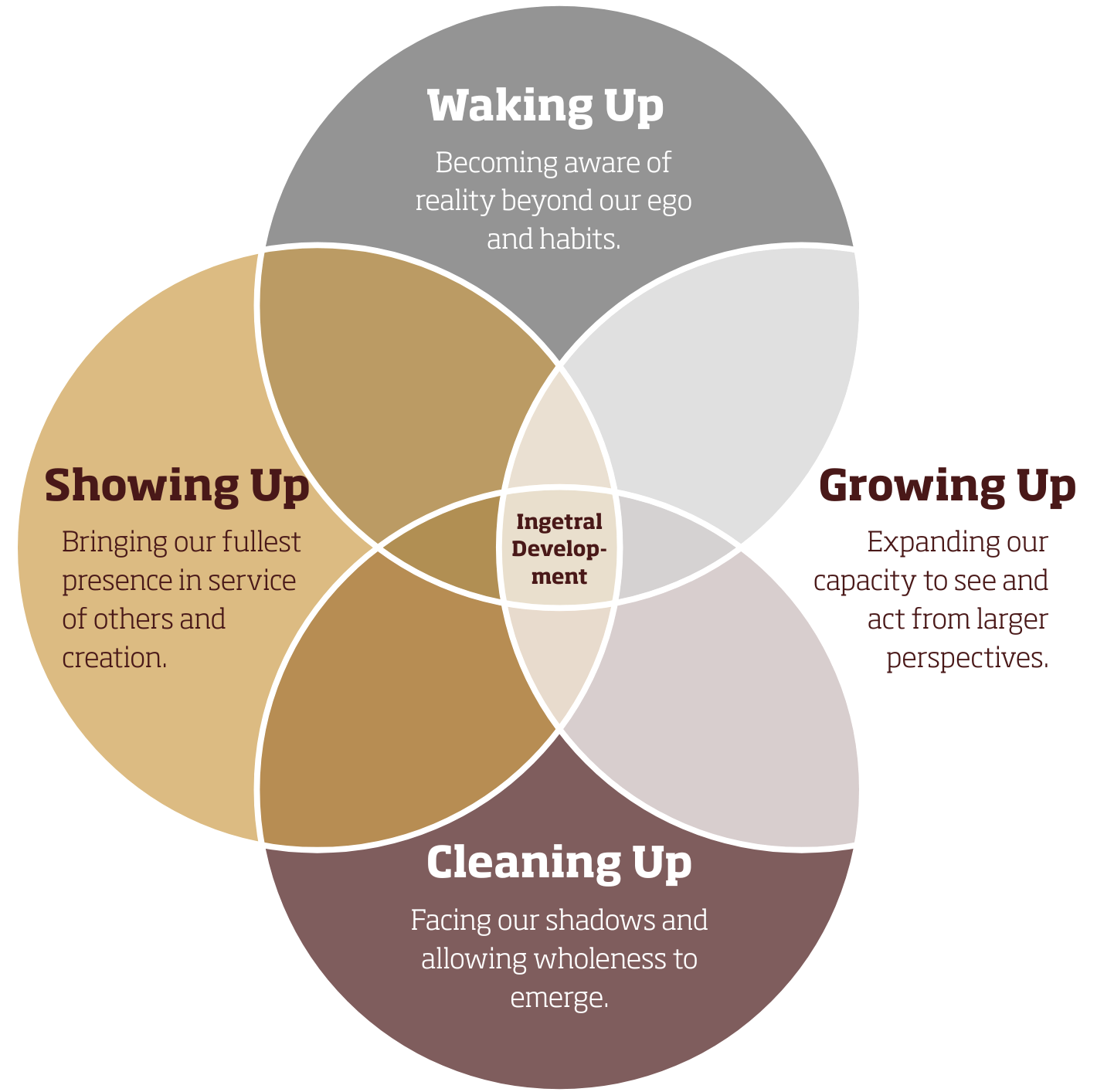
Waking Up – expanding awareness and presence
-
Growing Up – increasing developmental capacity
-
Cleaning Up – integrating shadow and reactivity
-
Showing Up – embodying leadership in action
By ensuring all these elements are woven throughout the program, leaders do not simply acquire new skills or frameworks.
They experience transformation across:
-
states of awareness
-
stages of maturity
-
shadow integration
-
embodied action
This ensures leadership development that is not only insightful, but sustainable, transferable, and deeply formative.
Metanoia for a Meta-Crisis
Transformation has always been at the heart of the Christian tradition.
At its core is the invitation to metanoia — a word often translated as “repent,” but whose original meaning is far richer and more demanding. Metanoia comes from meta (beyond or larger) and noia (to know). It does not simply mean turning away from what is sinful or wrong, but rather entering into a larger way of knowing — handing oneself over into a greater form of mind.
When Jesus proclaims, “Repent (metanoia), for the kingdom of God is at hand” (Matthew 4:17), the invitation is not primarily behavioural or moralistic. It is developmental. It is a call to awaken into a broader, more integrated consciousness capable of perceiving and participating in reality differently.
Paul’s exhortation makes this even clearer. “Put on the mind of Christ” and “Let the same mind be in you that was in Christ Jesus” (Philippians 2:5) point directly to the transformational principle at the heart of all wisdom traditions: transformation requires a new form of mind. Transformation is not the accumulation of better ideas, stronger beliefs, or improved behaviour. It is a shift in consciousness — a movement into a more mature, spacious, and integrated way of knowing.
This insight, preserved within the Christian contemplative and theological tradition, is now strongly echoed by adult developmental psychology. Decades of research show that as the complexity of the world increases, effective leadership depends not on more knowledge alone, but on growth in the form of mind through which reality is interpreted.
We are now living within a genuine meta-crisis — ecological, social, moral, and institutional — marked by unprecedented complexity and uncertainty “out there.” Meeting this reality cannot be done from the same inner structures that were sufficient in simpler times. As complexity increases externally, it must be matched by increased capacity internally.
This is the heart of development — and of formation.
As leaders grow developmentally, they expand their capacity to participate within a larger, more unitive whole. Their actions may look familiar on the surface, but the source from which those actions arise has shifted. They are no longer driven primarily by fear, certainty, or control, but by discernment, integration, and responsibility for the whole. In the language of Scripture, they are transformed by the renewing of the mind.
This program stands within that lineage — reclaiming formation as the developmental work required for faithful, mature, and effective leadership in a complex world.
Program overview
Duration: 6 months
Participants: 8–14 leaders
Who it’s for: Faith-based community service leaders
Format:
-
In-person gatherings at a retreat space in Forth, Tasmania
-
Individual developmental coaching sessions (in-person or Online)
-
Collective learning and peer reflection
Core tools:
-
Developmental coaching
-
Contemplative practice
-
Enneagram
-
Conscious Leadership
-
Adult development frameworks
Cohort: Cross-organisation
Intake: Annual
Status: Expressions of interest open

Who This Is For
This program is designed for senior managers who:
- Carry significant responsibility
- Are navigating complexity, uncertainty, and human systems
- Are no longer satisfied with surface-level leadership development
- Want to know themselves and others more deeply
- Are ready to grow into the next stage of leadership
World-Class Tools for Transformational Leadership
The iEQ9 Enneagram System
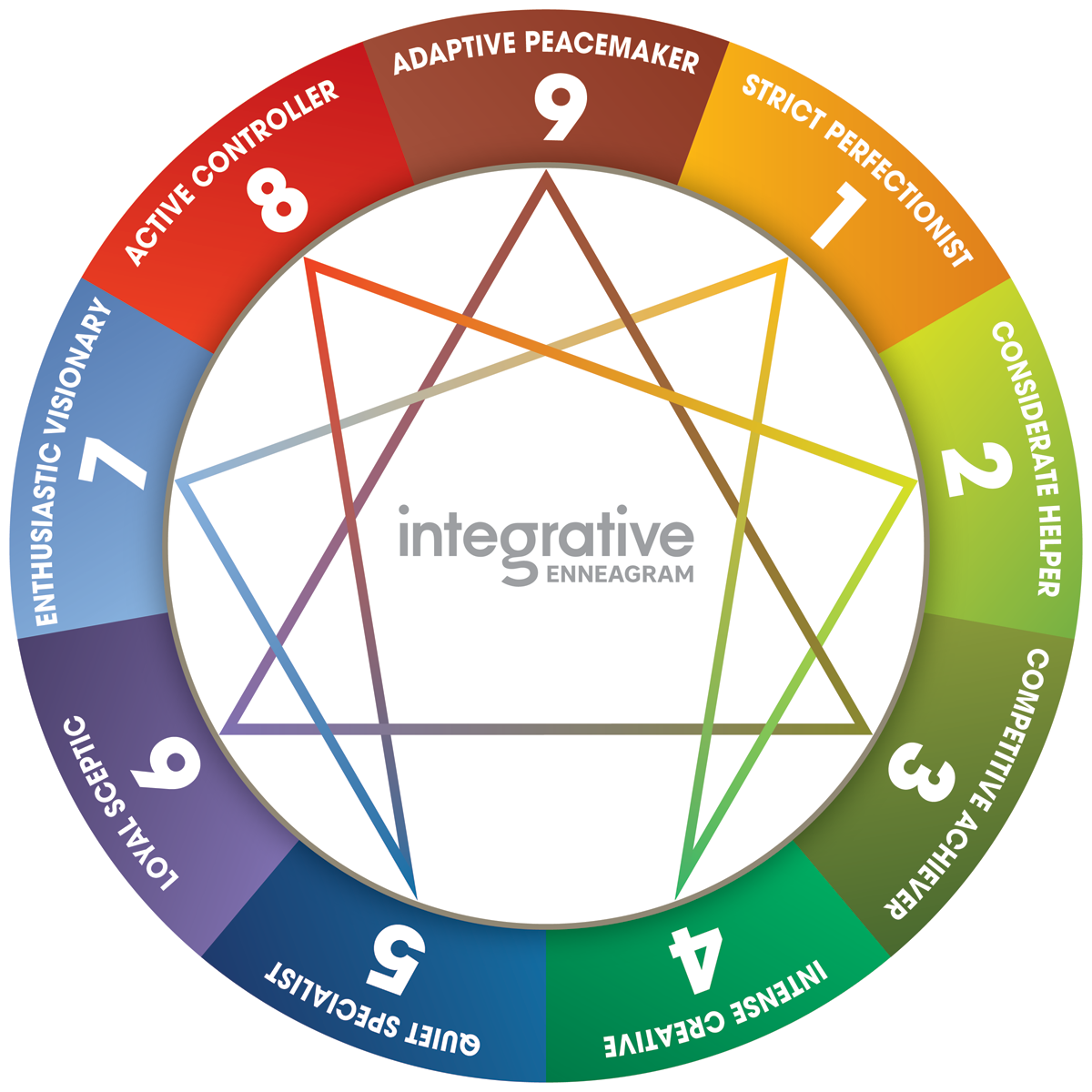
The Enneagram is one of the most powerful tools available for self-understanding and the development of emotional intelligence in leadership. This sophisticated personality assessment uncovers core motivations, habitual behaviours, and key growth areas.
It describes nine distinct personality types, each with characteristic ways of thinking, feeling, and acting. The iEQ9 system generates a detailed, research-based report that highlights strengths, developmental challenges, and common blind spots, supporting deep self-awareness and more conscious leadership.
With reported accuracy rates of up to 95%, iEQ9 helps leaders recognise the patterns that drive their reactions under pressure, expand their range of responses, and build greater adaptability and emotional intelligence — making it a leading tool for both personal and professional development.
Conscious Leadership
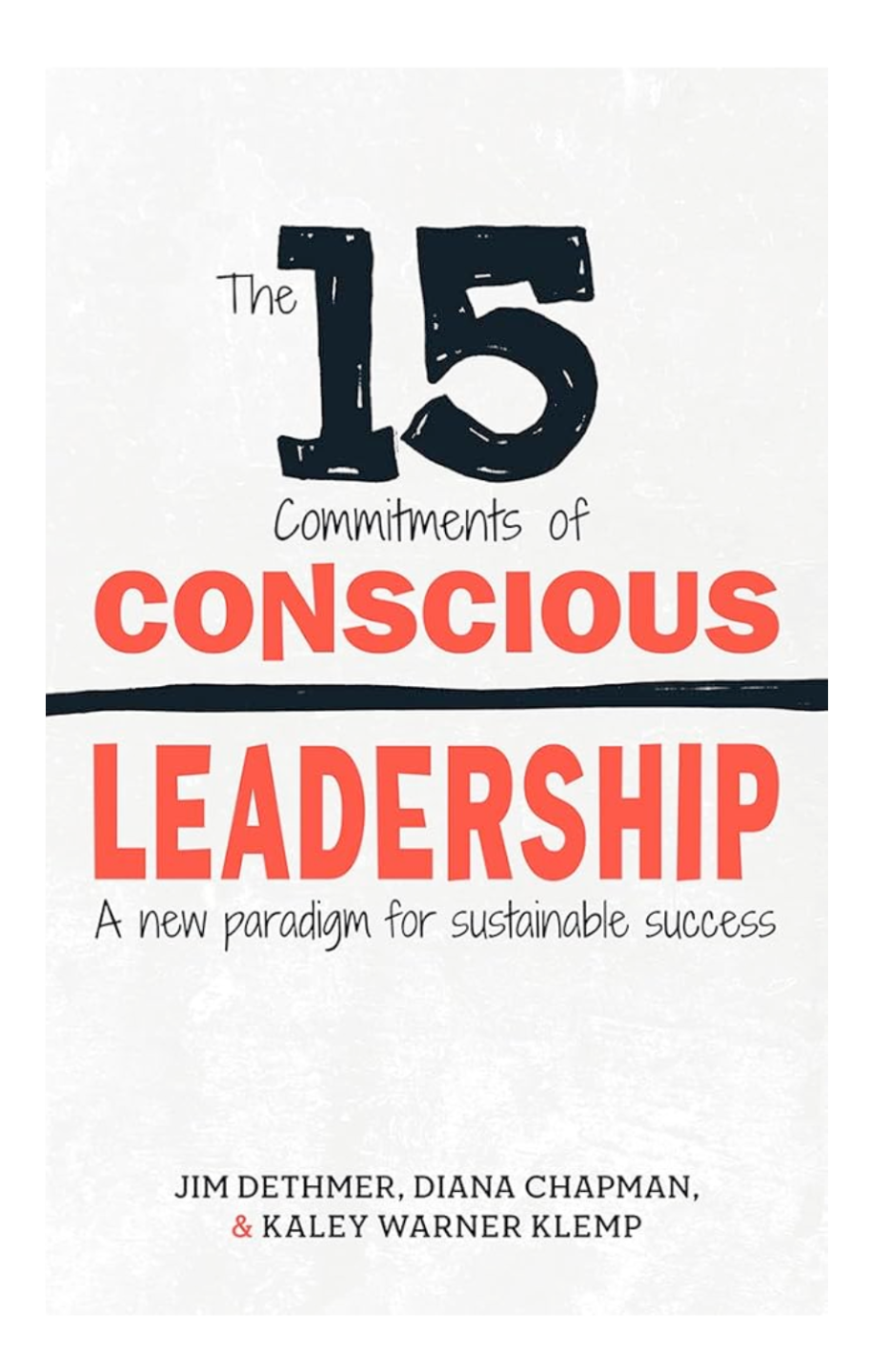
Rooted in the Conscious Leadership Group’s 15 principles, this approach focuses on the essentials that matter most in real leadership moments — shifting states, acting with integrity, taking responsibility, and choosing to show up from trust rather than fear.
These principles are expressed through pragmatic, practical, and accessible tools that leaders can use immediately. Simple in form yet profound in impact, they help leaders recognise when they’re operating on autopilot, shift into presence, and lead with greater clarity, ownership, and effectiveness — individually and together.
STAGES International Assessment
At a certain point in leadership, growth is no longer about learning more or working harder. Many capable leaders reach a moment where the real question becomes: what kind of capacity is now required of me?
This developmental assessment is designed to answer that question.
Rather than measuring personality or skills, it explores how you make meaning of the world — the inner structure through which you interpret experience, relate to complexity, and exercise leadership. It focuses not on what you know, but on how you know.
This approach is grounded in more than forty years of research in adult developmental psychology, which shows that adults continue to grow through identifiable stages of development across the lifespan. Each later stage brings increased capacity to navigate complexity, uncertainty, and responsibility.
The assessment uses a sentence-completion method with a long history of rigorous validation. Unlike self-rated or fixed-choice tools, it reveals how you actually think and make meaning across a wide range of life contexts. From this, a developmental “centre of gravity” is identified — a reliable snapshot of how your leadership capacity is currently organised, and where it is beginning to stretch.
The value of this assessment is not in labelling where you are, but in clarifying what is next.
By understanding your stage of development, you gain insight into why certain challenges persist, why leadership demands may feel heavier, and what kind of growth is now required to lead well and sustainably. The assessment includes a detailed written report and a debrief conversation, where results are explored in the context of your real leadership situation.
Leaders consistently describe this process as deeply clarifying and affirming. It helps shift developmental challenges from personal strain to meaningful growth.
This is why the assessment matters.
As leaders grow in how they know, they develop greater capacity to hold complexity without collapse, stay present with difference, discern ethically without certainty, and carry responsibility for the whole. The assessment offers a clear and credible way to understand your next stage of leadership — and the development required to meet it.

Expected Outcomes
The outcomes of this program unfold across three levels:
Within the Leader
-
greater self-awareness and inner authority
-
leadership grounded in presence and integrity
-
increased capacity to navigate complexity, diversity and ambiguity
Within Teams and Communities
-
stronger trust and collaboration
-
healthier engagement with difference
-
leadership that invites growth rather than dependence
Within Organisational Culture
-
renewed integration of faith and practice
-
sustained learning embedded in daily leadership
-
resilient, adaptive cultures that enable people to flourish
Ultimately, transformed leaders shape transformative cultures — becoming a steady, discerning presence in complex systems of service and care.
Register Your Interest
Leader Formation is offered once per year and places are limited.
Registering your interest allows us to:
-
notify you when applications open
-
share further details
-
explore whether this program is a good fit
There is no obligation.
If this resonates, you are warmly invited to register.
About Your Facilitator
Ben Pangas is a leadership development specialist, counsellor, and certified developmental coach with more than twenty years’ experience working across construction, education, and community development.
Ben’s work sits at the intersection of professional leadership practice, adult developmental psychology, and contemplative formation. He specialises in supporting leaders who are navigating complexity, responsibility, and change — particularly in values-driven and faith-informed contexts.
He holds a Master’s degree in Coaching Psychology, a Bachelor’s degree in Counselling and Coaching, and qualifications in youth and community work, training and assessment, and counselling. Ben is also a Graduate of the Center of Action and Contemplation's' 2 year formative 'Living School' Program.
His background also includes over a decade working in the construction industry, which gives him a grounded understanding of real-world leadership pressures, operational demands, and accountability.
This combination of practical experience and developmental expertise shapes Ben’s approach. He works with leaders not by offering quick fixes or techniques, but by helping them grow the inner capacity required to lead with clarity, maturity, and integrity in complex environments.
Ben has facilitated leadership development, coaching, and formation programs across community services, health, local government, and faith-based organisations. His work is known for being thoughtful, rigorous, and deeply human — integrating reflective practice, developmental insight, and practical application in ways that translate into lasting impact.